


Micro-Investing in Crypto lets you build a serious position with tiny, repeatable buys. Instead of waiting for a perfect entry, you automate contributions, keep fees low, and nudge spare change toward blue-chip assets like BTC, ETH, and SOL. Because contributions are small yet consistent, volatility hurts less while compounding helps more. Moreover, you can run this strategy alongside a normal budget without stress. In this guide, you’ll set up a secure stack, choose allocations, and apply daily playbooks that fit real life. Finally, you’ll get concise answers to common questions so you can move from theory to action today.
Best micro investing in crypto: start small, stack blue chips
Best micro investing in crypto starts with automation and discipline: set tiny recurring buys (£3–£5/day or £25–£50/week) you’ll never cancel, then route them into blue-chip BTC/ETH/SOL.
The best micro investing in crypto approach minimizes frictions-low fees, simple rules, and a wallet you actually use-so habits survive volatility.
Keep a 2–3 coin core, batch-withdraw monthly to cut network costs, and raise contributions only when income rises.
This way, best micro investing in crypto becomes a boring, repeatable system that compounds without decision fatigue.
Why micro-investing works
Small, scheduled buys reduce timing stress. Additionally, frequent contributions increase the number of market “samples,” which smooths entries across volatility. Over months, this improves behavioral discipline, which is the real edge for most retail investors.
Choose your blue-chip core
Anchor with 2–3 majors (e.g., BTC, ETH, SOL). Limit long-tail bets to a small satellite so your core does the heavy lifting. Because liquidity is deeper in majors, you’ll see tighter spreads and simpler exits.
Automate round-ups
If your provider supports purchase round-ups, funnel the difference (e.g., £2.60 → £3.00) into your DCA bucket. Otherwise, set a weekly calendar trigger and move a fixed amount manually.
Set your stack: wallets, on-ramps, and safety first
A clean stack prevents headaches. Hence, use this minimal setup
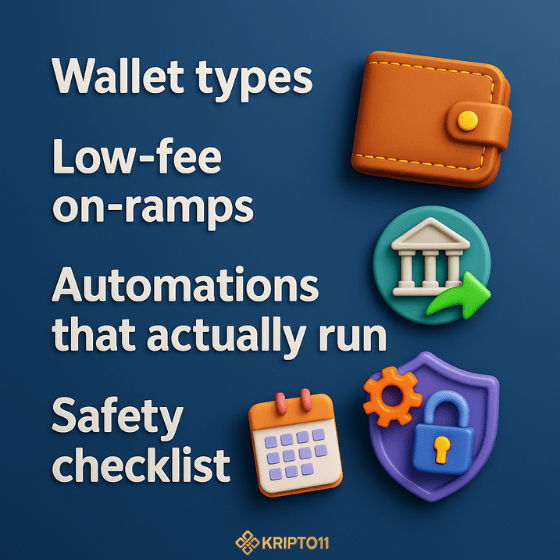
Wallet types
- Everyday app wallet: Easy sends, small balance, daily use.
- Long-term hardware wallet: Holds the core; connect sparingly.
- Exchange account: Only for buys; withdraw promptly.
Because security matters, back up seed phrases offline. Moreover, enable 2FA (authenticator app), use a password manager, and withdrawal when possible
Low-fee on-ramps
Prefer bank transfers or providers with transparent spreads. Therefore, compare total cost: explicit fees plus price slippage. Even a 0.5–1.0% difference compounds across hundreds of small buys.
Automations that actually run
Set recurring purchases on a weekday you’ll remember. Then, withdraw to self-custody in larger batches (e.g., monthly) to amortize network fees without letting exchange risk accumulate.
Safety checklist
Update OS, browser, and wallet apps. Bookmark official sites. Never type your seed phrase on any website. Finally, test a small withdrawal before moving size.
From pennies to positions: simple allocation templates
Allocations must be simple enough to follow during chaos.
The 60/20/20 core
- 60% BTC for digital scarcity and macro hedge
- 20% ETH for smart-contract platform exposure
- 20% SOL for high-throughput ecosystem upside
Because this is a starting point, adjust based on conviction and time horizon.
Risk-tier guardrails
- Core (70–90%): BTC/ETH/SOL
- Growth (10–25%): large-cap Layer-1s or liquid staking derivatives
- Explore (0–5%): experiments you can emotionally write down to zero
Therefore, when markets pump, resist inflating Explore.
Rebalancing cadence
Use quarterly calendar rebalancing or ±5% tolerance bands. Consequently, you buy relative losers and trim relative winners automatically, which reinforces discipline.
Fees and slippage control
Batch withdrawals once per month. Prefer maker orders when practical. Moreover, avoid thin liquidity pairs during illiquid hours.
Real-life playbooks: turn routines into crypto flow.
Micro-Investing in Crypto thrives when it rides existing habits.
Coffee to coin
Route card rewards to your DCA wallet. For example, £8 in weekly cashback becomes a tiny BTC/ETH/SOL buy. Over a year, that’s 52 automatic contributions—no extra effort.
Subscription skimming
Audit recurring services. Cancel one underused app and redirect that £7–£12 monthly into your DCA. Therefore, the same budget funds your stack.
Side-hustle siphon
Commit 10–20% of freelance or marketplace income to the core bucket. Because variable income spikes, this rule converts windfalls into long-run positions.

Volatility responses
Pre-decide “dip rules,” e.g., add +25% DCA size on 15–20% weekly drawdowns, capped at one boost per month. Consequently, you lean into weakness without overtrading.
Analytics, habits, and growth loops.
You manage what you measure.
Track the right KPIs
Monitor three numbers monthly: total contributed, average cost basis per asset, and total fees as % of contributions. If fees >1.0–1.5%, optimize your route.
Habit design
Tie contributions to a cue (payday, coffee run). Keep the routine one tap. Reward yourself with a quick dashboard check. Because the loop is simple, you’ll keep doing it.
Education drip
Add a 20-minute weekly learn: wallet security, L2s, staking basics, tax rules. Moreover, log one action item each week so learning compounds into behavior.
When to scale up
After a raise or side-income uptick, increase DCA by a fixed £ amount. Alternatively, bump DCA by 10% whenever your emergency fund reaches 3–6 months of expenses.
FAQ – Micro-Investing in Crypto
Q1. What is Micro-Investing in Crypto, exactly?
A. It’s a habit system that routes tiny, frequent contributions into blue-chip coins using automation, low fees, and simple rules.
Q2. How much should I start with?
A. Begin with an amount you’ll never cancel-£25–£50 weekly-then scale as income grows.
Q3. Which coins fit best?
A. Focus on BTC/ETH/SOL for depth and durability. Keep experiments ≤5%.
Q4. Is self-custody required?
A. It’s strongly recommended for long-term holdings. Back up your seed offline and enable 2FA everywhere.
Q5. How do I reduce fees?
A. Use bank transfers when cheaper, compare spreads, and batch monthly withdrawals to self-custody.
Q6. What if prices crash after I buy?
A. Stick to your cadence. Optionally apply a pre-set dip boost once per month. Avoid emotional trading.
Q7. How do taxes work?
A. Track buys, sales, and transfers. Use a portfolio tracker or tax tool to export reports per your jurisdiction.
Q8. When should I rebalance?
A. Quarterly or when allocations drift ±5%. Keep rules simple and consistent.
Quick Action Checklist
- Pick a contribution you won’t cancel.
- Choose a 60/20/20 or similar allocation.
- Set recurring buys on a fixed weekday.
- Batch-withdraw monthly to a hardware wallet.
- Track contribution, cost basis, fee % each month.
- Add a weekly learn and one action item.
Final thoughts
Because discipline compounds, Micro-Investing in Crypto works best when boring. Therefore, codify the plan, automate the moves, measure the few numbers that matter, and protect your keys. Over time, those tiny buys stack into a blue-chip bag you’re proud of-without wrecking your budget or your nerves.




Pingback: Digital Gold vs. Physical Gold: Which Wins the Next Decade?
Pingback: nflation Hedges Reimagined: Bitcoin and Bullion in 2025-2035
Pingback: Liquidity Wars: Trading NFTs vs. Gold in Bear and Bull Markets - KRIPTO11
Pingback: The memecoin pump and dump: Cycles That Never End - KRIPTO11
Pingback: KYC freeze drama: risks for gambling crypto on telegram users
Pingback: When crypto trading bots shine-and when they totally break - KRIPTO11
Pingback: KYC-free marketplace: NFT investment risk - no ID verification