

The memecoin Pump and Dump: Cycles That Never End
Memecoins promise overnight freedom; the charts promise gravity. The memecoin pump and dump repeats because it blends human bias with thin liquidity and fast narratives. While each ticker looks new, the script rarely changes. Fortunately, patterns leave footprints-on-chain and in chat logs. Read them early and you’ll sidestep the trap, keep your bankroll intact, and even use the signals to say “no” faster.
Insider Dumping and the Flywheel of Hype

“Insider Dumping” is the moment the story dies. Early wallets-devs, promoters, or seed buyers-sell into retail bids while the headline meme trends. Although the slogans sound fresh, the mechanics stay old: seed accumulation → staged marketing bursts → thinly veiled endorsements → coordinated sells. During a memecoin pump and dump, insiders don’t dump once; they scale out in waves around catalysts (exchange rumors, influencer threads, or fake partnerships).
Because each wave temporarily pauses, late buyers confuse the lull for “support.” It isn’t. It’s inventory management. Therefore, track transfer patterns from known team wallets, watch for synchronized sells after each hype event, and assume that viral attention often equals exit liquidity unless data proves otherwise.
How the Cycle Starts: Narratives, Telegram Rooms, and Thin Liquidity
A cycle needs fuel. Narratives provide it. First, a simple story appears: a mascot, a joke ticker, a celebrity wink. Next, Telegram rooms coordinate: they seed “alpha,” pin price targets, and post cropped PnL screenshots. Meanwhile, liquidity remains thin by design. Most pools launch with small initial depth, so even modest buys move price vertically.
Because the chart rises fast, screenshots spread, and more buyers arrive. Consequently, the promoter updates the narrative (“CEX listing soon,” “burn incoming,” “partnership tomorrow”). Since participants anchor to round numbers, the room celebrates “0.0001” as if it implies value. It doesn’t. It merely amplifies the next wave of bids.
Crucially, the supply story stays fuzzy. Tokens claim burns “soon,” or unlocks “later,” or a “community treasury” without multisig transparency. Yet those very knobs control your outcome. If a meme trades like a carnival ride, ask who runs the levers.
On-Chain Red Flags You Can Measure
Hype talks; data counts. Before you touch a new ticker, check these on-chain diagnostics. They won’t predict the top; however, they will filter bad setups.
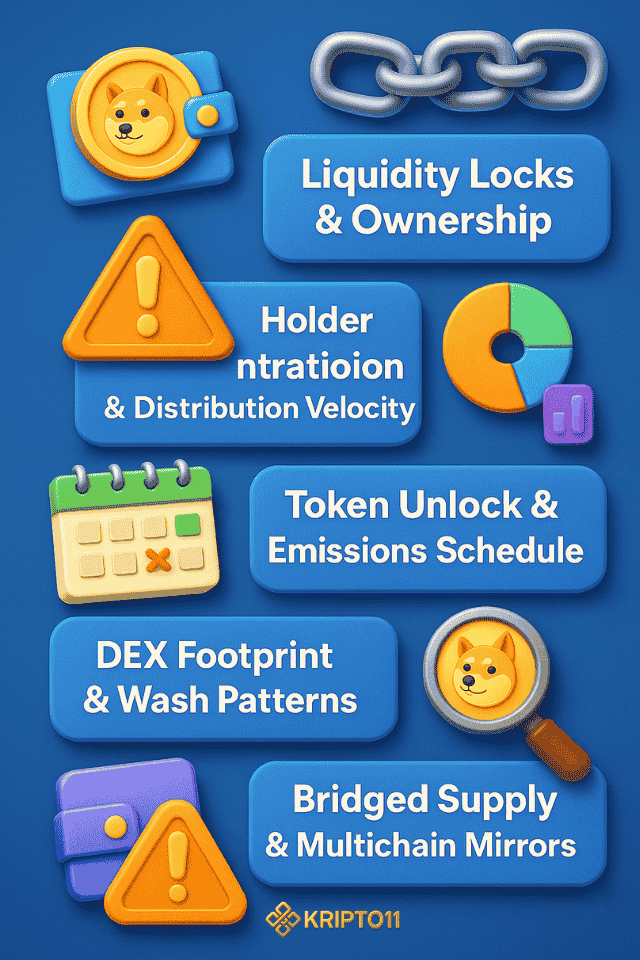
1) Liquidity Locks and Ownership
Look for LP tokens locked in a reputable locker for a specific period. If the deployer still owns the LP or can pull it quickly, exit. Additionally, inspect “mint” and “freeze” authorities for tokens on chains that support them. Revocable permissions equal unilateral power.
2) Holder Concentration and Distribution Velocity
Open the holder tab and rank by balance. If the top ten wallets own a majority, volatility will be violent. Furthermore, measure distribution velocity: do early wallets spread out to fresh addresses right after the first 2–3x? Rapid splitting often precedes coordinated sells. Conversely, healthy growth shows incremental, organic holder counts with stable whale share.
3) Token Unlock and Emissions Schedule
Read the vesting chart. Even memes with “fair launches” sometimes hide future emissions through treasury wallets or “marketing funds.” Therefore, map estimated sell pressure by week. If a large unlock coincides with a marketing push, assume distribution, not magic.
4) DEX Footprint and Wash Patterns
Examine trade prints. Are many buys and sells the same size, repeating within seconds? That rhythm often hints at wash behavior designed to simulate activity. Moreover, compare volume to liquidity: if reported volume dwarfs pool depth, a tiny amount of net selling can nuke price.
5) Bridged Supply and Multichain Mirrors
Mirrors across chains create extra exit doors. If the bridge is centralized or the wrapped contract differs in permissions, risk rises. Consequently, a “good” chart on chain A might mask dumping via chain B.
Trading Psychology: Why Smart People Still Chase the Spike
Even disciplined people chase green candles. Why? Because memecoins compress casino dynamics into a social feed.
Fear of Missing Out (FOMO)
Screenshots act like sirens. You see a friend flip $200 into $6,000. Although you know survivorship bias, your brain discounts it. Moreover, every missed runner feels like a loss, so you compensate by chasing the next one.
Authority Bias and Social Proof
Blue-check accounts and “ex-hedge-fund” bios add false legitimacy. If several public figures retweet the same ticker, beginners assume diligence occurred. It rarely did. Instead, assume incentives: traffic, affiliate links, or a bag to unload.
Gambler’s Fallacy and Break-Even Urge
After a loss, people try to “get back to even.” Memes offer fast payback fantasies, so traders raise size when they should reduce it. As a result, one bad bounce can consume a month of careful work.
Variable Rewards and Habit Loops
Occasional big wins keep the loop alive. Intermittent reinforcement—wins at random intervals—creates the stickiest habits. Therefore, design personal friction (cool-down timers, pre-committed limits) so a green candle cannot hijack your plan.
Defensive Playbook: Survive the Next memecoin pump and dump
You cannot control promoters. You can control process. Build one that defaults to “no,” then requires strong data to flip to “yes.”
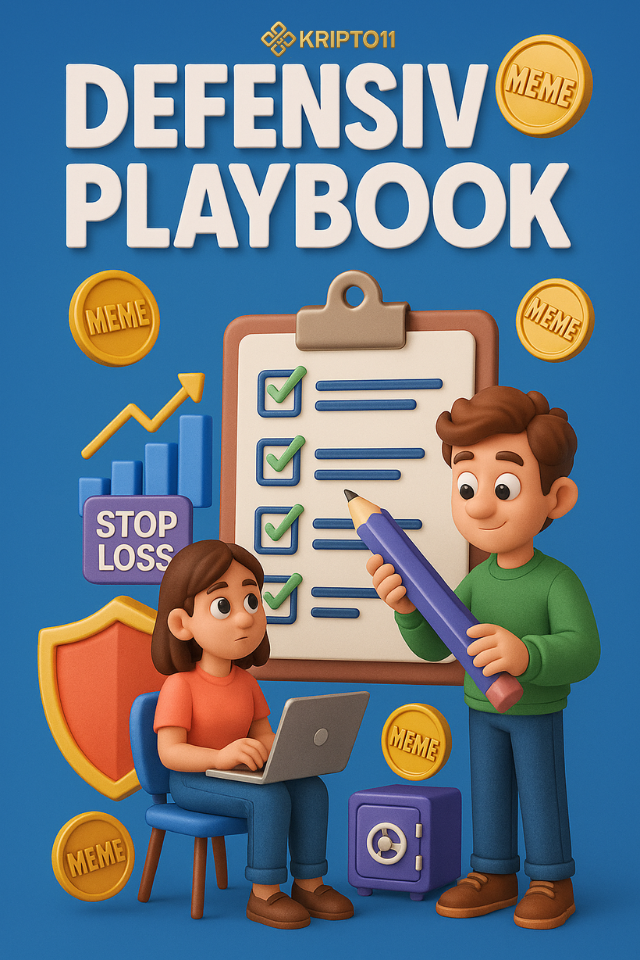
1) Pre-Trade Checklist (Pass/Fail)
- LP status: locked for a credible period; deployer renounced critical permissions.
- Top-10 share: below your threshold (e.g., <35% combined).
- Emissions map: clear vesting; no giant cliff aligned with “big news.”
- Documentation: plain-English tokenomics; named multisig signers; public treasury.
If any box fails, skip. Because opportunity cost beats capital loss.
2) memecoin Pump and Dump:Entry Rules
- Enter on pullbacks into rising liquidity, not on vertical spikes.
- Size with fixed risk per trade (e.g., 0.5–1.0% of account at stop).
- Use time-based invalidation: if your thesis catalyst does not arrive by a set date, exit flat or small red.
3) Exit Rules-memecoin Pump and Dump
- Ladder out into strength. Moreover, move stops to breakeven after a set RR (e.g., +1.5R).
- If whale wallets start distributing, reduce. If LP unlock nears, reduce again.
- Never average down on a meme. Capital preservation compounds; hope does not.
4) Information Diet
- Favor on-chain dashboards over influencer threads.
- Mute Telegram rooms that post targets without audits.
- Additionally, log each trade: setup, data, result. Over 30 trades you’ll see whether memes help or harm your equity curve.
5) Account-Level Safeguards
- Separate speculative wallets from your core long-term stack.
- Use hardware wallets for the core. Keep hot wallets small.
- Rotate fresh addresses; revoke spend approvals regularly.
Because a memecoin pump and dump often ends with phishing attempts against the same audience that bought the token.
6) Psychological Anchors
- Pre-commit a daily loss limit and a weekly red line; stop trading when hit.
- Insert a cool-down rule after any >2R win to prevent victory tilt.
- Schedule no-trade windows around major unlocks and marketing events.
FAQ : memecoin Pump and Dump
Q1: What is a memecoin Pump and Dump in plain terms?
A: It’s a coordinated cycle where promoters push a meme token up through hype and thin liquidity, then sell inventory into retail bids. Prices surge fast and collapse faster.
Q2: How does insider dumping usually look on-chain?
A: You’ll see early wallets funding multiple fresh addresses, then distributing in bursts around news. Often, LP remains shallow and top-10 concentration stays high despite rising holder counts.
Q3: Can I safely trade a meme if I follow strict rules?
A: You can reduce risk, not remove it. Use a pass/fail checklist, fixed-risk sizing, and pre-planned exits. Additionally, never treat memes as investments; treat them as short-lived trades.
Q4: What single red flag should make me walk away immediately?
A: Unlocked LP or revocable mint/freeze authority controlled by the deployer. If someone can pull liquidity or mint more supply, your edge is imaginary.
Q5: I’m already down bad-what now?
A: Stop averaging. Close according to a predefined max loss. Then review your process: where did you ignore data, and which rule would have saved you? Finally, rebuild with smaller size and stricter filters.