
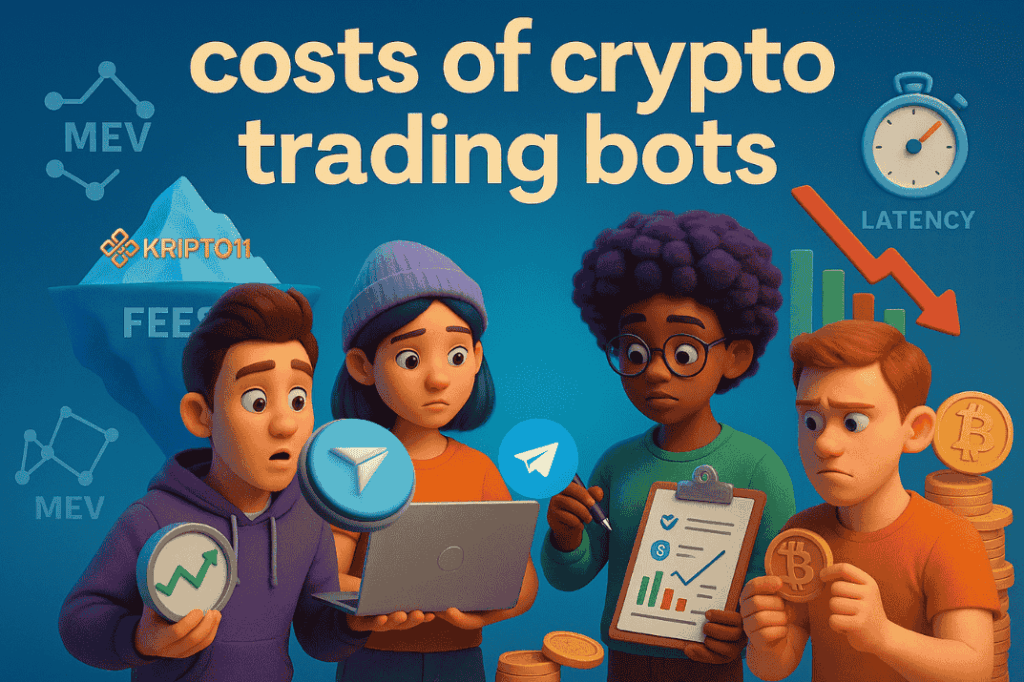

You can wire a beautiful signal engine, yet still bleed value on every execution. Why? Because the costs of crypto trading bots don’t stop at maker-taker fees. They lurk in spreads, funding, latency, queue position, gas, MEV, routing errors, and even your backtest assumptions. This guide breaks down each leak, then shows how to plug it-without strangling your edge.
Free crypto trading bot: what “free” really costs

“Free crypto trading bot” sounds perfect. However, nothing in execution is truly free. Even if you avoid subscription fees, you’ll still pay:
- Exchange costs: maker/taker fees, spreads, and hidden price impact.
- Network costs: gas on-chain, bridge fees across L2s/L1s, and withdrawal charges.
- Market structure costs: slippage from latency, poor queue position, and thin liquidity.
- Opportunity costs: downtime, missed fills, and under-optimized routing.
Therefore, treat “free” as no software fee, not zero cost. When you evaluate any free crypto trading bot, ask: What are the implicit costs in execution, connectivity, and reliability and how big are they versus my expected edge?
A quick sanity check
- If your edge per trade is 10 bps but average all-in cost runs 14 bps, you’re paying to trade.
- If your win rate depends on micro-latency, a “free” stack hosted far from matching engines loses queue priority and turns you into the exit liquidity.
Fees, spreads, and funding: the obvious costs that still surprise
Even sophisticated builders underestimate the compounding drag of basic line items. Let’s quantify the costs of crypto trading bots here.
Maker-taker fees
- Taker fees hit when you cross the spread; fast strategies often require it.
- Maker rebates can help, but only if you truly rest liquidity without adverse selection. Otherwise, you collect a rebate and eat a worse fill when the Crypto market moves through you.
Spread and price impact
- The spread is a real cost every time you cross. On thin pairs, it dwarfs fees.
- Price impact grows with order size relative to displayed (and hidden) liquidity. Break orders; don’t hammer books.
Perpetual funding and borrow
- Perps charge funding, which can flip from receipt to payment across regimes (Ex. Solana pay).
- For spot shorting or basis trades, borrow rates and rebates move around; re-check them daily.
Conversion, transfer, and withdrawal fees
Moving collateral between venues to chase fills often adds network and withdrawal fees. Net those against expected improvements before you shuffle funds.
Latency, slippage, and queue position: where edge quietly leaks
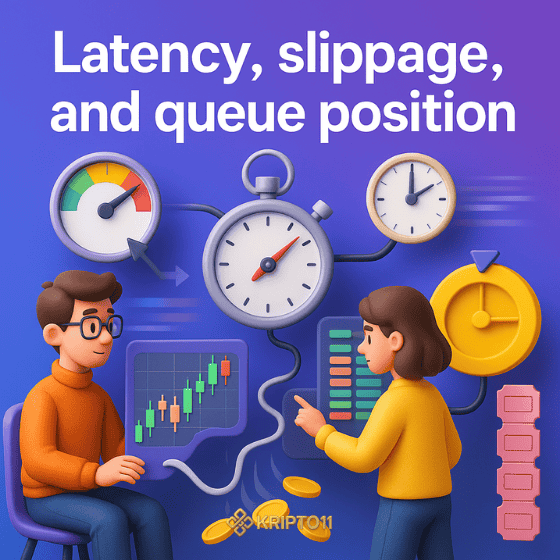
Execution isn’t only about price; it’s also about when your order hits the book.
Latency sources you control
- Geography: Host close to exchange servers; multi-region if you’re cross-venue.
- Code path: Trim hops, compress payloads, and reuse TCP connections.
- Rate limits: Bursts cause throttles; stagger requests with token buckets.
Queue position and adverse selection
Resting as a maker helps until you sit behind thick queues and never get filled, or you get filled exactly when informed flow arrives. Therefore, monitor fill quality: if fills cluster just before adverse moves, you’re paying an information tax.
APIs, gas, MEV, and routing: hidden infrastructure leaks
The costs of crypto trading bots escalate when infra decisions lag behind strategy quality.
API quirks and data quality
- Websocket vs REST: Rely on websockets for book updates; REST only for fallbacks and order placement.
- Clock drift: Unsynced clocks cause signature errors and order rejects; use NTP everywhere.
- Stale snapshots: Validate incremental updates and resync on sequence gaps. Bad deltas = bad decisions.
On-chain costs: gas, MEV, and failed transactions
- Gas spikes: Event-driven bursts (airdrops, liquidations) increase gas right when you need fills. Budget dynamically.
- MEV and sandwich risk: Marketable swaps on AMMs can get sandwiched. Use private relays or batch auctions where available.
- Failed txs: Reverts still cost gas and time, creating both monetary and opportunity loss.
Routing and aggregation
- DEX routing: Poor path selection increases price impact; use robust aggregators with slippage caps.
- CEX venue selection: Compare fee tiers, spreads, and depth per pair per venue, not globally. Then rotate inventory to the cheapest, deepest venue, not the brand you like.
- Bridges: Bridge only when edge > bridge + gas + delay + risk. Otherwise, route signals to where collateral already sits.
Backtests vs live: controls that keep you honest (and profitable)
Even perfect code can’t rescue a biased experiment. Structure your research to reflect real costs.
Clean data and realistic latency
- Survivorship bias: Keep delisted pairs in your datasets.
- Look-ahead and peek: Lock timestamps; forbid future bars.
- Latency models: Add order-to-book and book-to-fill delays that match production p99, not p50.
Execution modeling that matches reality
- Slip by size and depth: Tie slippage to order size relative to top-of-book and depth across 5–10 levels.
- Partial fills: Simulate fractioned fills, re-queues, and cancels.
- Fee ladders: Use tiered fees and funding curves, not a single constant.

Position sizing, caps, and throttles
- Volatility-aware sizing: Scale down during regime shifts; expand in quiet liquidity.
- Daily leak caps: Stop trading for the day if cumulative costs of crypto trading bots exceed X bps.
- Strategy throttles: Limit concurrent signals per venue/pair to avoid self-induced impact.
Health checks and fail-safes
- Kill-switches: Trip on API error spikes, desync, or abnormal slippage.
- Shadow trading: Run paper side-by-side with live to detect drift.
- Post-trade attribution: Attribute P&L to alpha vs costs: fees, spread, slip, funding, gas, MEV, rejects.
costs of crypto trading bots
What are the main cost buckets?
Answer: Fees (maker/taker), spreads, price impact, funding/borrow, network/withdrawal, gas, MEV, latency-driven slippage, routing/bridge costs, rejects, and downtime.
Are “free” bots worth it?
Answer: Sometimes. However, you must compare total execution cost and reliability with your expected edge. If latency and routing are poor, free becomes expensive.
How do I measure slippage accurately?
Answer: Benchmark fills against the best bid/ask at order arrival time, not the time your strategy emitted the signal. Track pre-, at-, and post-trade slippage separately.
Can maker rebates offset costs?
Answer: They can help, but adverse selection can erase the gain. Monitor post-fill drift; if fills precede adverse moves, your rebate is fool’s gold.
What reduces MEV and sandwich risk on DEXs?
Answer: Private orderflow relays, RFQ-style venues, batch auctions, tighter slippage tolerances, and splitting orders across pools with depth.
What’s a practical target for all-in cost?
Answer: It varies by pair and venue. As a rule of thumb, aim to keep all-in costs below 50–60% of your expected edge per trade. Otherwise, you’re just paying the market.
How do I stress-test before going live?
Answer: Add a 2–3× multiplier to your measured backtest costs for worst-case stress, then recheck profitability. If it still holds, deploy small and ramp gradually.

Implementation checklists
Cost controls (daily/weekly)
- Daily P&L attribution by cost bucket.
- Venue spread/fee depth table per pair; rebalance collateral weekly.
- Latency dashboard with p50/p95/p99 and queue-position metrics.
- Route audits: DEX path quality and CEX venue hit-rate.
Execution guardrails
- Per-trade slippage cap; auto-cancel if breached.
- Max order size as % of top-of-book or 5-level depth.
- Funding/borrow alerts when rates exceed thresholds.
- Gas budgeters on-chain; fail over to private relays during spikes.
Backtest integrity
- Sequence-checked market data with delisted assets intact.
- Realistic delay and partial-fill modeling.
- Fee ladders, funding curves, and bridge/withdrawal costs included.
- Shadow/live diff report with automatic alerts.



Pingback: Celebrity Cash-Grabs : why nfts are bad in 2025 - KRIPTO11
Pingback: Ethereum fomo 2025 prediction: MEV and What Traders Miss
Pingback: Is XRP or Solana Better? for Newbies Who Hate Tech Jargon?
Pingback: NFT-Friendly Blockchain Wallet : Minting, and Not Getting Rekt